> ## Documentation Index
> Fetch the complete documentation index at: https://wb-21fd5541-style-guide-models-reports-20260604-104120.mintlify.site/llms.txt
> Use this file to discover all available pages before exploring further.
# Create a collection
> Create a collection of linked artifact versions within a W&B Registry and configure accepted artifact types.
This page explains how to create a collection within a W\&B Registry and configure the artifact types it accepts.
A *collection* is a set of linked artifact versions within a registry. Each collection represents a distinct task or use case.
For example, within a registry you might have multiple collections. Each collection contains a different dataset such as MNIST, CIFAR-10, or ImageNet.
As another example, you might have a registry called `chatbot` that contains a collection for model artifacts, another collection for dataset artifacts, and another collection for fine-tuned model artifacts.
How you organize a registry and their collections is up to you.
If you're familiar with W\&B Model Registry, you might know about registered models. The W\&B Registry now refers to registered models as *collections*.
## Collection types
Each collection accepts one, and only one, *type* of artifact. The type you specify restricts which artifacts you, and other members of your organization, can link to that collection.
You can think of artifact types similar to data types in programming languages such as Python. In this analogy, a collection can store strings, integers, or floats but not a mix of these data types.
For example, suppose you create a collection that accepts `dataset` artifact types. You can only link future artifact versions of type `dataset` to this collection. Similarly, you can only link artifacts of type `model` to a collection that accepts only model artifact types.
You specify an artifact's type when you create that artifact object. See the `type` field in `wandb.Artifact()`. Replace the bracketed placeholders with your own values:
```python theme={null}
import wandb
# Initialize a run
with wandb.init(
entity = "[TEAM-ENTITY]",
project = "[PROJECT]"
) as run:
# Create an artifact object
artifact = wandb.Artifact(
name="[ARTIFACT-NAME]",
type="[ARTIFACT-TYPE]"
)
```
When you create a collection, you can select from a list of predefined artifact types. The artifact types available to you depend on the registry that the collection belongs to.
Before you link an artifact to a collection or create a new collection, [check which artifact types the collection accepts](#check-the-artifact-types-a-collection-accepts).
### Check the artifact types a collection accepts
Before you link to a collection, inspect the artifact type that the collection accepts. This helps you avoid link errors caused by mismatched artifact types. You can inspect the artifact types that a collection accepts programmatically with the W\&B Python SDK or interactively with the W\&B UI.
An error message appears if you try to link an artifact to a collection that doesn't accept that artifact type.
You can find the accepted artifact types on the registry card on the homepage or within a registry's settings page.
For both methods, first navigate to your W\&B Registry.
Within the homepage of the W\&B Registry, you can view the accepted artifact types by scrolling to the registry card of that registry. The labels within the registry card list the artifact types that the registry accepts.
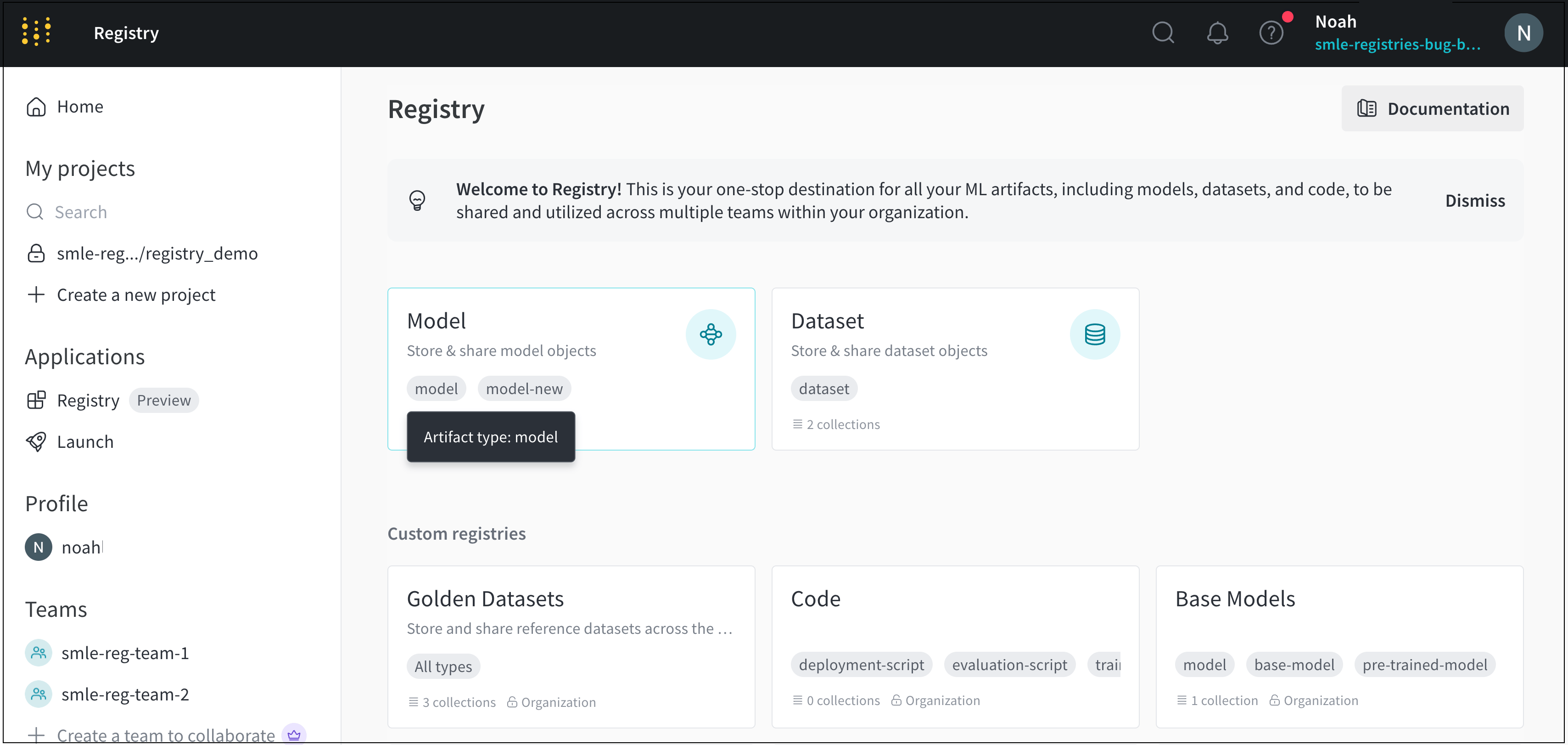 For example, the following image shows multiple registry cards on the W\&B Registry homepage. Within the **Model** registry card, you can see two artifact types: `model` and `model-new`.
To view accepted artifact types within a registry's settings page:
1. Click the registry card you want to view the settings for.
2. Click the gear icon in the upper right corner.
3. Scroll to the **Accepted artifact types** field.
Programmatically view the artifact types that a registry accepts with the W\&B Python SDK:
Replace `[REGISTRY-NAME]` with the name of your registry:
```python theme={null}
import wandb
registry_name = "[REGISTRY-NAME]"
artifact_types = wandb.Api().project(name=f"wandb-registry-{registry_name}").artifact_types()
for artifact_type in artifact_types:
print(artifact_type.name)
```
The following code snippet doesn't initialize a run. You don't need to create a run if you're only querying the W\&B API and not tracking an experiment, artifact, and so on.
Once you know what type of artifact a collection accepts, you can [create a collection](#create-a-collection).
## Create a collection
Interactively or programmatically create a collection within a registry. You can't change the type of artifact that a collection accepts after you create it.
### Create a collection programmatically
Use the `wandb.Run.link_artifact()` method to link an artifact to a collection. Specify both the collection and the registry to the `target_path` field as a path that takes the form of:
```python theme={null}
f"wandb-registry-{registry_name}/{collection_name}"
```
Where `registry_name` is the name of the registry and `collection_name` is the name of the collection. Append the prefix `wandb-registry-` to the registry name.
W\&B automatically creates a collection for you if you try to link an artifact to a collection that doesn't exist. If you specify a collection that exists, W\&B links the artifact to the existing collection.
The following code snippet shows how to programmatically create a collection. Replace the bracketed placeholders with your own values:
```python theme={null}
import wandb
# Initialize a run
with wandb.init(entity = "[TEAM-ENTITY]", project = "[PROJECT]") as run:
# Create an artifact object
artifact = wandb.Artifact(
name = "[ARTIFACT-NAME]",
type = "[ARTIFACT-TYPE]"
)
registry_name = "[REGISTRY-NAME]"
collection_name = "[COLLECTION-NAME]"
target_path = f"wandb-registry-{registry_name}/{collection_name}"
# Link the artifact to a collection
run.link_artifact(artifact = artifact, target_path = target_path)
```
After this code runs, the artifact links to the specified collection, and W\&B creates the collection automatically if it doesn't already exist.
### Create a collection interactively
The following steps describe how to interactively create a collection using the W\&B Registry:
1. Navigate to the W\&B Registry at [https://wandb.ai/registry/](https://wandb.ai/registry/).
2. Select a registry.
3. Click the **Create collection** button in the upper-right corner.
4. Provide a name for your collection in the **Name** field.
5. Select a type from the **Type** dropdown. Or, if the registry enables custom artifact types, provide one or more artifact types that this collection accepts.
6. Optional: Provide a description of your collection in the **Description** field.
7. Optional: Add one or more tags in the **Tags** field.
8. Click **Link version**.
9. From the **Project** dropdown, select the project where your artifact is stored.
10. From the **Artifact** collection dropdown, select your artifact.
11. From the **Version** dropdown, select the artifact version you want to link to your collection.
12. Click the **Create collection** button.
For example, the following image shows multiple registry cards on the W\&B Registry homepage. Within the **Model** registry card, you can see two artifact types: `model` and `model-new`.
To view accepted artifact types within a registry's settings page:
1. Click the registry card you want to view the settings for.
2. Click the gear icon in the upper right corner.
3. Scroll to the **Accepted artifact types** field.
Programmatically view the artifact types that a registry accepts with the W\&B Python SDK:
Replace `[REGISTRY-NAME]` with the name of your registry:
```python theme={null}
import wandb
registry_name = "[REGISTRY-NAME]"
artifact_types = wandb.Api().project(name=f"wandb-registry-{registry_name}").artifact_types()
for artifact_type in artifact_types:
print(artifact_type.name)
```
The following code snippet doesn't initialize a run. You don't need to create a run if you're only querying the W\&B API and not tracking an experiment, artifact, and so on.
Once you know what type of artifact a collection accepts, you can [create a collection](#create-a-collection).
## Create a collection
Interactively or programmatically create a collection within a registry. You can't change the type of artifact that a collection accepts after you create it.
### Create a collection programmatically
Use the `wandb.Run.link_artifact()` method to link an artifact to a collection. Specify both the collection and the registry to the `target_path` field as a path that takes the form of:
```python theme={null}
f"wandb-registry-{registry_name}/{collection_name}"
```
Where `registry_name` is the name of the registry and `collection_name` is the name of the collection. Append the prefix `wandb-registry-` to the registry name.
W\&B automatically creates a collection for you if you try to link an artifact to a collection that doesn't exist. If you specify a collection that exists, W\&B links the artifact to the existing collection.
The following code snippet shows how to programmatically create a collection. Replace the bracketed placeholders with your own values:
```python theme={null}
import wandb
# Initialize a run
with wandb.init(entity = "[TEAM-ENTITY]", project = "[PROJECT]") as run:
# Create an artifact object
artifact = wandb.Artifact(
name = "[ARTIFACT-NAME]",
type = "[ARTIFACT-TYPE]"
)
registry_name = "[REGISTRY-NAME]"
collection_name = "[COLLECTION-NAME]"
target_path = f"wandb-registry-{registry_name}/{collection_name}"
# Link the artifact to a collection
run.link_artifact(artifact = artifact, target_path = target_path)
```
After this code runs, the artifact links to the specified collection, and W\&B creates the collection automatically if it doesn't already exist.
### Create a collection interactively
The following steps describe how to interactively create a collection using the W\&B Registry:
1. Navigate to the W\&B Registry at [https://wandb.ai/registry/](https://wandb.ai/registry/).
2. Select a registry.
3. Click the **Create collection** button in the upper-right corner.
4. Provide a name for your collection in the **Name** field.
5. Select a type from the **Type** dropdown. Or, if the registry enables custom artifact types, provide one or more artifact types that this collection accepts.
6. Optional: Provide a description of your collection in the **Description** field.
7. Optional: Add one or more tags in the **Tags** field.
8. Click **Link version**.
9. From the **Project** dropdown, select the project where your artifact is stored.
10. From the **Artifact** collection dropdown, select your artifact.
11. From the **Version** dropdown, select the artifact version you want to link to your collection.
12. Click the **Create collection** button.